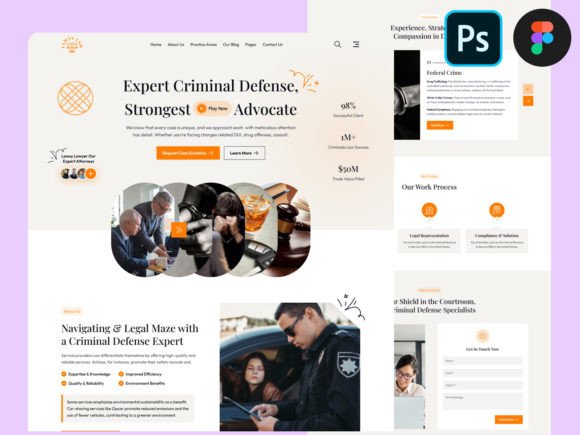
Criminal Defense Law UI PSD Figma: A Strategic Asset for Professional Web Development
In the competitive landscape of digital presence, the choice of foundational design assets can dictate the trajectory of a professional brand. The Criminal Defense Law UI PSD Figma template represents more than a collection of visual elements; it is a strategic framework designed to accelerate the deployment of high-fidelity websites for legal professionals and adjacent service industries. For entrepreneurs, marketers, and decision-makers, understanding how to leverage this specific resource requires a shift in perspective from viewing it as a mere download to treating it as a structured planning tool. When utilized with intention, this template supports critical goals in branding, operational efficiency, and customer experience.
The core value proposition of the Criminal Defense Law UI PSD Figma lies in its adaptability. While the name suggests a niche focus on legal defense, the underlying architecture—built upon a robust Bootstrap Grid System and organized within 1600px full-width artboards—is universally applicable. This makes it an ideal starting point for business consulting services, financial advisors, insurance brokers, investment consultants, life coaches, and wellness coaches. The modern UI and unique design elements provided allow these diverse sectors to establish a credible online footprint without the prohibitive costs and time investments associated with building from scratch.
Strategic Positioning Through Predefined Design Systems
One of the most significant advantages of adopting the Criminal Defense Law UI PSD Figma is the immediate access to a cohesive design system. In the realm of web development, consistency is not merely aesthetic; it is a functional requirement for user trust. The template includes well-organized layers, named groups, and components based on Figma styles, which ensures that every element from vector icons to typography adheres to a unified standard. This pre-alignment allows professionals to focus their energy on content strategy rather than pixel-perfect alignment.
For a lawyer or a business consultant, the initial impression formed by a website often determines whether a potential client engages further. The "Minimal Modern Design" inherent in this template leverages free fonts from Google Fonts to create a clean, readable interface that communicates professionalism. By utilizing the 01 Unique Artboards included in the file, designers can rapidly prototype different scenarios, testing how various messaging strategies fit within the layout before committing to development. This iterative process reduces risk and ensures that the final product aligns closely with the organization's strategic objectives.
Optimizing Operations and Productivity
Time is a finite resource for any entrepreneur or small business owner. The Criminal Defense Law UI PSD Figma template is engineered to maximize productivity through its fully customizable and 100% vector-based nature. Unlike raster images that lose quality when scaled, vector graphics ensure that the design remains crisp across all devices, from desktop monitors to mobile screens. This responsiveness is critical, as a significant portion of traffic now originates from tablets and smartphones.
The inclusion of both Figma and PSD files offers flexibility for teams with varying technical stacks. Whether a team prefers the collaborative capabilities of Figma or the legacy workflow of Photoshop, the dual-format delivery ensures that no one is left behind. Furthermore, the template's foundation on the Bootstrap Grid System (Grid 1170px) means that the transition from design to code is streamlined. Developers can easily map the visual hierarchy to HTML structures, significantly reducing the time spent on front-end coding. This efficiency translates directly into cost savings and faster time-to-market, allowing businesses to capitalize on opportunities sooner.
Adapting the Framework for Diverse Industries
While the primary context is criminal defense law, the structural integrity of the Criminal Defense Law UI PSD Figma allows for seamless adaptation across multiple service-oriented sectors. Consider the needs of an advertising consulting firm or a financial advisor. Both require a presentation of authority, clarity, and trustworthiness. The predefined web elements—such as testimonial sections, service grids, and contact forms—are generic enough to be repurposed yet specific enough to guide the user journey effectively.
For instance, a life coach or wellness coach might utilize the template's layout to showcase personal stories and program offerings. The "Creative and unique design" elements, including amazing vector illustrations, can be swapped out to reflect a softer, more approachable tone while maintaining the site's structural stability. Similarly, investment consultants can leverage the same grid system to present complex data and market insights in a digestible format. The key is to recognize that the template provides the skeleton; the flesh and blood come from the specific content and branding of the individual business.
Decision-Making and Long-Term Value
Before integrating the Criminal Defense Law UI PSD Figma into a project, stakeholders must engage in thoughtful decision-making. It is essential to assess whether the template's aesthetic aligns with the long-term vision of the brand. A common pitfall is selecting a design solely because it is available or affordable, without considering how well it serves the target audience. For adults aged 20–50, particularly those who are digitally savvy, a website that feels outdated or overly generic can be detrimental to credibility.
However, when used intentionally, this template offers substantial long-term value. The "Easy to Find Artboards, Folders, Layers, Components" feature set ensures that future updates are manageable. As a business grows, its website must evolve. The ability to modify the design without breaking the layout structure is a crucial asset. This scalability supports the lifecycle of a business, from startup to established enterprise, ensuring that the digital presence remains relevant and effective over time.
Furthermore, the template encourages best practices in web development. By adhering to the Grid 1170px standard, the resulting website will likely perform better in search engine rankings due to improved load times and mobile compatibility. Search engines prioritize user experience, and a well-structured, responsive site is a key component of that experience. Therefore, investing in a high-quality template like the Criminal Defense Law UI PSD Figma is an investment in organic visibility and sustainable growth.
Risks of Contextless Implementation
Despite its many benefits, there are risks associated with using the Criminal Defense Law UI PSD Figma without a clear strategic plan. One such risk is the creation of a "cookie-cutter" appearance. If a business simply downloads the files and publishes them without customizing the copy, imagery, and color palette to reflect their unique identity, they risk blending into the background. In competitive fields like insurance brokering or legal services, differentiation is paramount.
Another potential issue arises when users attempt to force the template into a use case for which it is ill-suited. While highly customizable, the fundamental layout may not support highly interactive applications or e-commerce platforms requiring complex backend integrations. It is vital to understand the limitations of the template and supplement it with additional development work where necessary. Relying solely on the template without assessing specific functional requirements can lead to frustration and wasted resources.
Practical Planning and Execution Tips
To maximize the utility of the Criminal Defense Law UI PSD Figma, practitioners should follow a structured approach. First, audit the existing brand guidelines to determine which elements of the template need modification. Second, map out the user journey for the target audience, ensuring that the navigation and call-to-action placements within the template support desired outcomes. Third, leverage the vector icons and illustrations to reinforce key messages visually, rather than treating them as mere decoration.
Collaboration is also key. Since the file comes with well-organized layers, it is easier for designers, developers, and content strategists to work together seamlessly. Regular reviews of the design against the strategic goals should be conducted throughout the process. This ensures that the final output not only looks good but also functions as a powerful tool for business development.
Ultimately, the Criminal Defense Law UI PSD Figma is a versatile instrument in the digital toolkit. It empowers professionals to make informed decisions about their online presence, balancing speed, cost, and quality. By approaching it with a strategic mindset, businesses can transform a standard template into a bespoke platform that drives engagement, builds trust, and achieves measurable results.